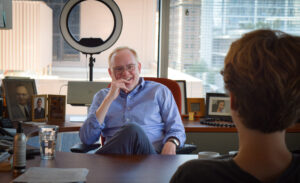

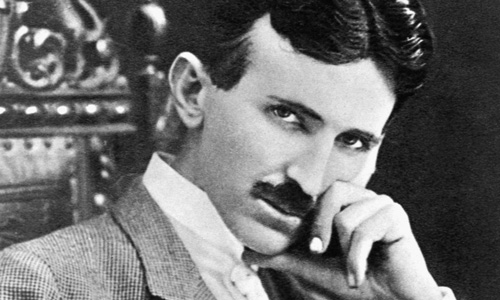
John Wasik is a personal finance columnist, blogger and award-winning author of 16 books. His latest, Lightning Strikes: Timeless Lessons in Creativity from the Life and Work of Nikola Tesla, examines the creativity and innovation of the famous inventor, inspiring readers to find the same in their own lives. The Reynolds Center recently spoke to him about the book and what business journalists can learn from Tesla.
What are you most proud of with this book?
It became a hybrid project that combined a lot of different disciplines to get the book I wanted. It took time and it’s something I felt good about in the end because it pulled a lot of things together. The publisher got a whole bunch of illustrations in there and it is the first augmented reality book I know of on this subject—maybe on a lot of other subjects as well. It’s totally multimedia and it connected with Tesla because he was really ahead of his time. Not that I think this book is revolutionary, but I think it offers modern readers a reason to discover not only the subject—one of the greatest inventors ever—but themselves as well.
What skills are needed when you investigate someone so thoroughly?
In my case, I had to pile through a lot of documents. My rule of thumb is you have to go through a thousand different citations to get one real nugget. You have to say, “I’m not just reporting this, I’m looking for something new, revealing, interesting and something that will be significant.” The whole book was touched off by one letter that I found in an archive that totally blew me away, because I didn’t know Tesla was communicating with this other guy—a guy I was writing a book on. I didn’t know what he was asking him, so it took me years to figure out what he was talking about and then it led so many different directions. It’s such a detective story because you find this thing that sort of pops up and slaps you in the face and says, “Hey, look, here’s a story, go look for it.”
What are some of the challenges you faced writing and researching this book and how did you overcome them?
I have to say in terms of figuring out where Tesla’s papers went, I kind of failed. As a reporter I have a gut feeling they’re sitting in some huge box in a government warehouse somewhere. Maybe someone has looked at them, maybe someone has used them for some other purpose, but I don’t know. And I’ve talked to every expert out there and they don’t know. I only got one reply from all of my Department of Defense FOIAs. Even then, I went to my congressman and asked what I had to do to get a response.
Sometimes you hit a dead end, but it’s not necessarily the end. If you have more time you work on it, if not you move on and you go with what you have. That’s just a basic thing in reporting. You figure out what you can do and what seems feasible in the amount of time you have. After awhile I said I’m just going to write a different book. I couldn’t solve this one problem, but I could open up a few different doors, so why not go in that direction? You just have to be flexible.
What can journalists learn from Tesla’s life?
For one thing, collaboration is always good. There’s the myth of the lone reporter pursuing the one big story. You have to leverage a lot of different skills and contacts and there is no one way to do it. Get out there, talk to as many people as you can. Some people are going to sound like absolute lunatics, but they may have something to say. Keep your mind open and have this mental flexibility that something might lead to something else, you just have to look at it a different way.
If anything, this book was a metaphor for a different kind of journalism. There are many good biographies on Tesla [that go into] much more detail, but I wanted to answer the question, “What was it about his way of thinking that can really help us?” I love the way he could visualize, the whole process of taking an idea and walking it through, what it looks and feels like, how you sketch it out. I think that’s essential to journalists. Some of these stories are so complicated, especially in business. What was this CEO thinking? How do you get into his head? You’re not going to have access to him, so how do you reverse engineer what happened? All that’s really important because it helps you tell the story. We’re storytellers, so how do you put it all together? You need a lot of details, but you have to see them, you have to hear them, you have to be in the room. I think the best business journalists do that.
What draws people to Tesla and what keeps him relevant all these years later?
He had ideas. The ideas survive. The whole concept that you could do something that was very bold, very innovative and even fail in a big way. How many people are out there saying, “I think most of America can own electric cars that we can recharge by having solar cells and batteries in our houses, totally disrupting the whole grid idea [of being] plugged in and burning coal.” Guys like Elon Musk truly believe this and they’re truly doing it. I think it’s that steel-eyed vision of how to make something happen and then going ahead and doing it. Then they have to sell it. They have to convince others that it will be good for people, that it will be good for the planet. You have to believe in it and just work through it.
I think that [challenge is] facing a lot of people in our business today because mainstream media is shrinking. But there are other opportunities. Are you just someone who reports on stuff? Do you get involved or do you advocate? One of the most important things to come out of this book is that anybody can be an innovator. Anybody can take ideas and do something with them. You don’t have to say, “Oh, I’m not the creative type or an inventor.” I’m going to Maker Faires, I’m going to be talking to kids who are tinkering around with stuff. This is what you should be doing. Take it apart, smash it up and try something new.
Review copies of Lightning Strikes: Timeless Lessons in Creativity from the Life and Work of Nikola Tesla are available by contacting Blanca Oliviery at Sterling Publishing: boliviery [at] sterling