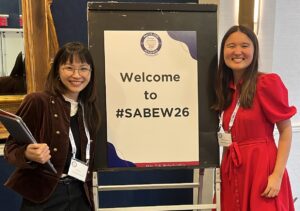

I was interested in two core themes at Sabew’s 2026 conference. First, learning from some reporters I deeply admire about how they approach their work and unpick complex reporting challenges. Second, taking a gut check on where business journalism is as an industry today, contending with huge shifts in audience behavior and threats to press freedom.
Did your source sign an NDA after they told their spouse?
A panel on building trust with reluctant sources was full of gold. 2026 Pulitzer winner Hannah Natanson talked about establishing rapport by demonstrating she’s just another human, breaking mid-phone call to admit her dog had just peed on the floor. The Washington Post reporter had her home raided by F.B.I. agents in January in one of those alarming threats to press freedom. I like to imagine the two events connecting in some way.
After the session, I spoke with panelist Khadeeja Safdar about working with sources who have signed non-disclosure agreements. Safdar, who has broken several stories about Jeffrey Epstein’s abuses with The Wall Street Journal, talked about thinking through everyone who might know the relevant information, and who they may have told. Did your source tell their spouse about what happened before they signed the NDA?
Where will the money come from in journalism’s shift to vertical video?
In October, I wrote a story for the Reynolds Center about the slew of magazines, newspapers and radio shows hiring social video producers to bring their reporting to TikTok and Instagram. No fewer than three panels at the SABEW conference took on the topic to some degree, but it remains unclear whether the pivot can really pay off while direct revenue streams remain meager and website referrals are just a trickle.
I asked about this at the end of one panel moderated by Erin Reynolds of The Philadelphia Inquirer. Reynolds said her paper is preparing to take a step some traditional outlets have been wary of: having video journalists present advertisements in their videos. A video on local real estate could incorporate a message for renters’ insurance, for instance.
Short-form video is undeniably where the audience is, and brand partnerships are certainly one of the few proven ways to turn those eyeballs into dollar signs. How it affects audiences’ perceptions of journalists’ independence is another matter, but I tip my hat to the Inquirer for trying this — I’ll be watching eagerly to see where it goes.
FOIA for their LLM logs
Are public employees’ AI chat transcripts public records? It depends on the jurisdiction, WIRED editor Tim Marchman said in a panel on FOIA strategies, but where you can get them, they can reveal a great deal. Happy FOIAing.
Newspaper man Charles Forelle heads to an embattled CBS News
Not everyone in the room enjoyed Semafor Editor Ben Smith’s sparring line of questioning in a lunchtime interview with CBS News Managing Editor Charles Forelle. I did.
CBS News has been frequently in the headlines as well as breaking them since the billionaire scion and Trump ally David Ellison bought the network in September. The acquisition and installation of a new editorial team — which includes Forelle and The Free Press founder Bari Weiss — has been read by some as “part of a deal … to make coverage more favorable to the Trump administration,” as Smith framed it in his first question for Forelle.
Forelle denied the claim. Yet answers to the vexing question of how to restore the network to anything close to the levels of public trust and audience scale it enjoyed in the days of Walter Cronkite were less declarative. Before joining CBS in October, Forelle covered business at The Wall Street Journal for 23 years, and acknowledged that “I am six months into my television life and don’t have all the answers.”
Smith pressed for them nonetheless, asking for a “diagnosis” of why the network’s viewing figures have been trending so steeply downwards since Weiss’s accession last fall. Forelle looked to a “bright spot”: “Around the big news events, we are seeing more viewers come to us,” he told Smith. “We had killer ratings on the White House Correspondents’ Dinner shooting.”
An audible wince rippled through a room full of correspondents at that choice of words. A transcript of the interview can be read here.
Energized
Much of my recent work has been on global energy markets — both for the Reynolds Center and in my work in Japan for Cronkite’s Borderlands project. It was great to hear from four of America’s leading journalists on this beat in a panel on data centers. The subject is riven with complex technical terminology and endless data points, and requires imagining what energy even is — when it cannot be simply seen or touched. With that in mind, it was great to hear The New York Times’ Ivan Penn stress the importance of good old-fashioned shoe-leather reporting. Get to know the receptionists as well as the CEOs of utility companies, Penn said. Keep your feet on the ground, and your reporting in the real world. Sage advice.