
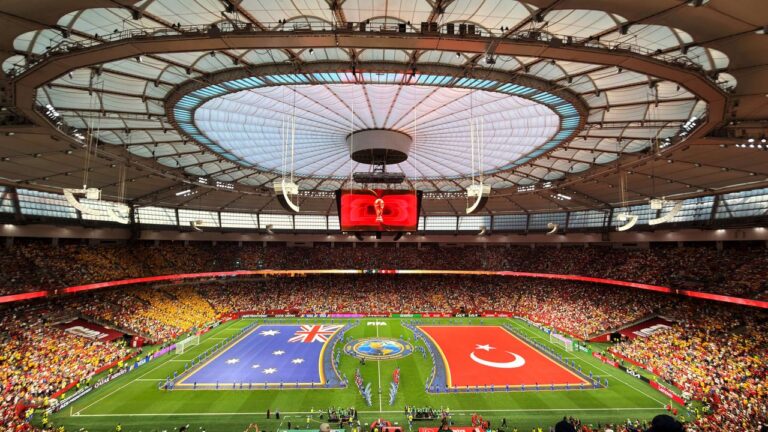
We are closing in on the final matches of the Men’s 2026 FIFA World Cup, currently being held jointly between Canada, Mexico, and the United States. The World Cup series occurs every four years and, over the past few weeks, these three countries have hosted teams from 48 nations, who will play a total of 104 matches in 16 venues by the time the winner is crowned on July 19.
A report from Bank of America estimated that 75% of the world (yes, world!) population will engage with some aspect of the tournament. That’s certainly a lot of people, and a lot of potential revenue.
The costs of hosting a major tournament
Compared to previous World Cups, the United States has spent considerably less preparing for the event than host countries of the past, largely due to the decision to spread out the matches among 11 stadiums that were already built. This includes Gillette Stadium in Boston, MA, where the New England Patriots play, and AT&T Stadium, home to the Dallas Cowboys. Increasing the number of host cities allows each city to use the infrastructure they already have rather than spend heavily to prepare for the massive influx of fans and players. For example, Brazil “allocated more than $12 billion from its budget to build stadiums, roads and transportation infrastructure for the 2014 World Cup,” and Russia spent over $14 billion to prepare for the World Cup in 2018. It’s estimated that the U.S. has spent only $1.2 billion on the tournament, predominantly to reinforce security for the events.
Host countries often anticipate that their investments will pay off with the increase in tourism for the event. Indeed, FIFA’s socioeconomic report estimates that the World Cup will increase the global GDP by $40.9 billion, with $17.2 billion of that in the U.S. alone. Additionally, the report predicted that the tournament would create 823,474 full-time equivalent jobs globally, and that the accommodation and food sectors would benefit the most.
A ‘non-event’ for some businesses
A sports economics professor noted that “FIFA’s estimates should be interpreted more as press releases than as serious economic studies…While we’re seeing large crowds and many foreign visitors, the money that U.S. fans spend on the World Cup is money that’s not [going to be used] for other forms of entertainment.”
In Seattle, where six matches have now been played, expectations of packed hotels and swarms of visitors didn’t quite pan out. In fact, before the tournament started, Sea-Tac had anticipated about 236 fewer flights during the tournament period than in 2025, representing a 1.6% decrease in flights. Hotels were also disappointed in May, because even though 5 million tickets were sold for the games, it had “not yet translated into strong hotel bookings” as “domestic travelers were outpacing international ones.” Some hotels in the region even described the World Cup as a “‘non-event’ due to FIFA room releases and weak international fan travel.”
While that $17.2 billion in GDP growth for the U.S. sounds like a benefit, it amounts to less than 0.1% of annual U.S. GDP.
Who is really benefiting?
Whether the World Cup is an economic benefit to the host countries and cities depends on who you are asking, but there is no doubt that the tournament is extremely profitable for FIFA itself. The nonprofit organization is expecting almost $9 billion in revenue this year. For context, the last World Cup in Qatar in 2022 generated $930 million for FIFA, and the last time the World Cup was held in the United States in 1994, FIFA generated $700 million in net revenue (approx. $1.58 million today).
About $3 billion in FIFA’s revenue is expected to come from ticket sales, which FIFA strictly controls. It even launched an official resell platform that charges both the buyer and seller 15%. The organization chose to use dynamic ticket pricing for the first time because “we are in the market in which entertainment is the most developed in the world. So we have to apply market rates,” said FIFA president Gianni Infantino. Many fans felt priced out of matches, and experts note that most of the money being spent on tickets is simply money that could have otherwise been spent locally on other venues or events.
A professor who researches sports finance stated that for host cities, “full hotels, busy restaurants and crowded fan festivals make compelling images, but they do not prove that the World Cup produced substantial net growth….The honest conclusion may be that the World Cup was a valuable shared experience without being a successful economic-development strategy.”