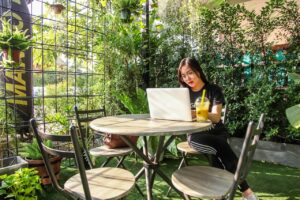

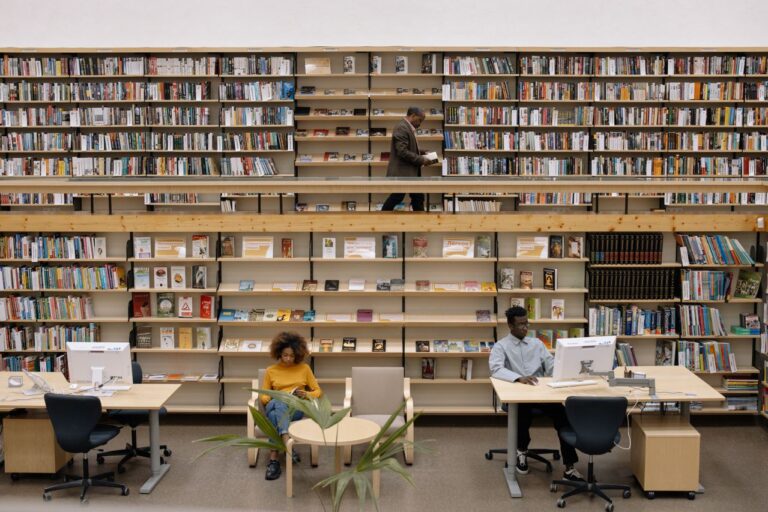
“The office” is becoming harder to define in the post-COVID era. For some workers, it is a desk in the corner of a living room or a spare bedroom. For others, it’s a coffee shop, a coworking space or, even, a public library.
Libraries have long been associated with books, quiet reading rooms, and rows of computers. But as remote work has changed where Americans spend their working hours, public libraries across the country are expanding their role as community workspaces.
From rural communities in Maine to the growing city of Mesa, Arizona, public libraries are adapting their spaces to accommodate people who need somewhere to join a meeting, collaborate with colleagues, study, launch their small business or simply get out of the house with their laptop.
Research from Australia suggests that this shift is not limited to communities in the United States. In a 2026 study published in the Journal of the Australian Library and Information Association, researchers surveyed 97 public library branches in New South Wales and Queensland to examine how libraries are accommodating remote workers. They found that 80% of responding libraries reported an increase in work-related use since 2022.
Maine invests in libraries as remote work infrastructure
Launched on August 3, 2023, the Maine State Library’s “Remote Work Through Libraries” Initiative went beyond providing financial support. It was designed to strengthen individual communities by helping libraries develop spaces and services tailored to local needs.
According to Marijke Visser, Director of Library Development at the Maine State Library, funding came through the state’s Department of Economic and Community Development, using money from the federal American Rescue Plan Act. The department sought ways to support remote workers, the economy and communities.
“The libraries are kind of a statewide infrastructure,” Visser said. “They really spread out across the state pretty well, and they’re even in more remote areas.” Maine has 256 public libraries, and she noted that most serve populations of less than 5,000 people.
The initiative funded 40 libraries to develop or enhance spaces for remote work, with each location adapting its approach to local circumstances. Some renovated existing areas, while others purchased technology, installed privacy features or created spaces for meetings and video calls.
As of July, participating libraries reported 48,175 workers using new or newly enhanced coworking spaces and 16,726 new remote worker library patrons. The figures were collected through quarterly reporting requirements, tracking overall users and new or non-repeat users. Although privacy principles limit the personal information Maine libraries can collect from patrons, the state compiles usage counts, broad surveys and community demographic data to understand its audiences.
“We definitely expanded the definition of what remote work is,” Visser said.
That broader understanding recognizes that a library workspace can serve more than just employees working independently at a laptop. Parents may work while their children use family-friendly spaces, and entrepreneurs and small business owners may need somewhere to manage their operations. The Australian research has similarly identified freelancers, entrepreneurs and small-business owners among those who use libraries as workplaces, whether working alone or alongside others.
According to the Australian Bureau of Statistics, 36% of employed people usually work from home. In the United States, The Bureau of Labor Statistics reported that 22.6% of employed people worked remotely. These numbers show the relevance of work arrangements and the potential for libraries.
In this sense, libraries are becoming flexible community infrastructure rather than alternatives to conventional offices. The benefits are shown in Maine’s coastal towns, where seasonal populations can change dramatically.
“The coastal libraries in particular have a big influx of population in the summer,” Visser said. “Some of the smaller towns, they double, triple in size.”
For seasonal visitors who work remotely, libraries can provide something they may not have at a vacation property: access to dependable internet access, workspace and equipment for professional meetings. In rural communities, they can also help bridge gaps in household broadband access.
Connectivity remains central to this role. Visser said roughly two-thirds of Maine’s libraries are part of the Maine School and Library Network, which provides high-speed internet access, email, web hosting and broadband connectivity to approximately 950 schools and libraries across the state.
“At home, we’re such a rural state. It’s still kind of iffy whether you’re gonna have a good enough broadband to do a virtual meeting, or whether you can afford it,” she said.
Libraries responded with outdoor Wi-Fi access, loanable laptops, and mobile hotspots, charging stations and improved video conference equipment.
However, reliable connectivity alone does not meet every remote worker’s needs. Video calls and confidential conversations require privacy and noise control, which can be difficult to provide in traditional library spaces.
Maine libraries found ways to address these concerns despite physical limitations. Visser said that some libraries operate in historic buildings, including structures listed on the National Register of Historic Places, where renovations may be restricted. Others may not have the infrastructure needed to install new wiring. To work around those limitations, some libraries purchased privacy pods and furniture with built-in charging stations.
Community input also shaped how the funding was spent. Rather than deciding independently what remote workers needed, participating libraries consulted residents before making purchases.
“The libraries looked and asked for input from the communities, but before they were spending the money to say, ‘what would you want if you had a remote workspace?’” Visser said.
Taking a community-centered approach distinguishes public libraries from traditional coworking businesses. Their goal isn’t to provide desks and office equipment, but to integrate remote work into their broader public service mission while responding to the practical needs of their community.
Mesa Gateway Public Library takes a flexible approach
Thousands of miles west, the Mesa Gateway Public Library illustrates another way public libraries can serve remote workers and the wider community.
In August 2026, the library received the 2026 International Federation of Library Associations and Institutions/James Bennett Public Library of the Year Award for its design, innovation and community impact.
The 28,000-square-foot library was designed around flexibility. As of December 2025, patrons had made more than 5,400 study-room reservations, accounting for over 9,000 hours of reserved study-room time, or roughly 136 reservations per week.
The library doesn’t track how many reservations are specifically for remote work, as patrons aren’t required to disclose their reasons for using the rooms. Jones noted that the spaces also serve students, tutors, families and other community members.
“I think a lot of people’s work now is collaborative,” Jones said. “When they’re looking for space outside their home, it’s often to meet with somebody else to work on something.”
To accommodate these needs, Gateway has individual study rooms, group rooms and a larger room that can hold up to six people. Flexible seating areas, free Wi-Fi, tables with integrated power and rooms equipped with screens provide additional options for meetings, presentations and video conferences.
This approach aligns with the Australian research suggesting that libraries do not need to operate as dedicated coworking facilities to support workers. Instead, adaptable spaces can serve different purposes and users throughout the day.
Gateway’s ThinkSpot and maker space provide another example of flexibility. When the space is not being used for 3D printing, its tables and chairs can be used for additional work or study space.
“It’s not always the maker space,” Jones explained during a tour of the facility. “It’s also tables and chairs and seats” for the people who need them.
The facility also includes a community room that can accommodate larger groups and a range of activities. These spaces prove how people use libraries to work, learn and gather together.
“More and more people want to use the library as a place to be in and not just a space to come and get a book and leave,” Jones said.
Libraries as a free workplace and “third place”
One of the main advantages of libraries as workplaces is that they are free and accessible to the public. Unlike traditional coworking spaces, which have a U.S. national median cost of $259 per month for memberships or $35 for day passes, libraries allow people to work without paying for a desk. They also provide an alternative to coffee shops, where customers are generally expected to make a purchase, and homes that may lack reliable internet or a suitable working environment.
For one remote worker who responded to an anonymous survey in Maine, this accessibility made a significant difference: “Quiet public spaces to remote work are so helpful for me. Private co-working spaces can be quite expensive and very noisy. I am so grateful to the Camden Public Library.”
Beyond affordability, libraries offer a change of environment for people who might spend their working days at home. Jones describes the library as one option on a remote workers “menu” of places to work, noting its flexibility by saying, “I think that’s another thing that makes the library attractive. You can come and go.”
This flexibility connects to the concept of a “third place”, a location outside the home and traditional workplace where people can spend time working and interacting with others. Libraries can provide a shared public setting for remote workers without requiring them to participate in a formal coworking community. Their value is not only providing a place to work, but also offering a place to be part of the wider community.
However, this role comes with challenges. Unlike coworking spaces, which can prioritize the needs of professional development, public libraries must accommodate all of their visitors. The Australian study found that some libraries reported concerns about remote workers occupying limited spaces for extended periods, increased noise and conflicts with other library activities.
These tensions highlight the difficulty of balancing different needs within a shared public space. Libraries must support remote workers while providing access for students, families, readers and other community members. Their success as third spaces depends not on becoming dedicated offices, but being inclusive to serve the wider public.
A new role for public libraries
The changing role of public libraries shows how people think about work and community space.
Maine and Mesa demonstrate different responses to that need. Maine takes a funding approach, providing statewide support that allows individual libraries to identify local needs and invest in technology and workplace resources. Mesa takes a flexible approach through its space design and adaptability, creating environments that accommodate multiple user groups.
Neither approach attempts to turn the public library into a corporate office. Instead, both recognized the opportunity that the modern library can serve everyone. Australian research suggests that this shift is occurring beyond the United States, but both Maine and Mesa demonstrate the future of library-based remote work will ultimately depend on the communities around them.
The office may no longer have one fixed location. It can be wherever people have the space, technology and connectivity to get their work done, and for many, that place may be their local library.