

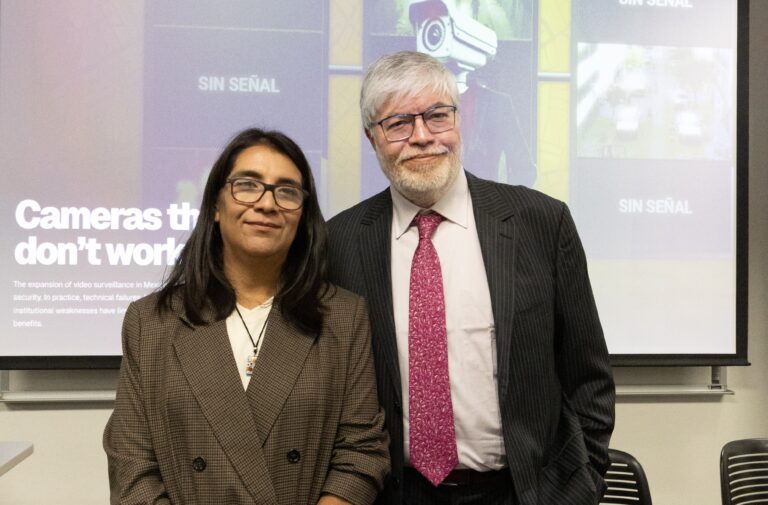
Mexico has invested heavily in surveillance technology to combat homicide, organized crime and disappearances. Yet as the number of cameras installed across the country has grown, so have the problems the systems were supposed to solve. For journalists Kennia Velázquez, Arnoldo Cuéllar and Mónica Cerbón, that contradiction became the starting point for The Profitability of Fear: How Insecurity Became a Business in Mexico, an investigation by POPLab and CONNECTAS into Seguritech, the largest provider of surveillance technology to state and municipal governments in Mexico and recipient of substantial amounts of public money.
The investigation examined government contracts, financial records and a network of companies connected to Seguritech, identifying suspicious commission payments and significant gaps in public accountability.
The findings reached Mexico’s highest political office. President Claudia Sheinbaum publicly addressed the investigation, criticizing companies that sell surveillance technology as offering “little mirrors” and announcing audits of Seguritech contracts receiving federal funding. In an interview with the Reynolds Center, Velázquez discussed how a denied freedom of information request developed into a broader investigation into public spending.
When secrecy became a warning sign
The investigation began with a seemingly straightforward question: How much money were Mexican governments spending on surveillance technology, and was that investment making people feel safer?
For the journalists, the question was urgent in Guanajuato, where homicide rates remained high despite substantial spending on security technology.
“We have the highest rates of homicide,” Velázquez explained in the interview. “The authorities have been spending a lot of money in this kind of technology and nothing changed, you know, year after year, it’s worse.”
The team submitted requests via Mexico’s version of the U.S. Freedom of Information Act for details about government expenditures and the use of surveillance technology. Velázquez said that authorities repeatedly refused to disclose the information, arguing that revealing details about security systems could help criminal organizations understand government capabilities.
The lack of transparency became an investigative lead. The reporters couldn’t establish the scale of public spending if governments withheld contracts and financial details, nor could the public evaluate if the technology was effective.
The investigation expanded when the team began identifying contracts involving Seguritech across different state and local governments, examining the company’s business relationships, subcontractors and financial transactions.
The reporters discovered that Seguritech hired numerous subcontractors to provide services. Some appeared to have little presence, questionable addresses, or no readily available contact information. The team began asking why public money was flowing to these businesses and services, and what they were actually providing.
Inside Seguritech’s corporate network
Once the reporters identified Seguritech’s network of subcontractors, the challenge became organizing a large volume of financial and corporate information without losing sight of where the money was going.
They used Mexico’s public commercial and property registries, government platforms managed by the Ministry of Economy, to examine companies’ legal names, registered owners and corporate connections. By searching for individuals as well as businesses, it helped them to identify relationships that were hidden behind commercial names or public-facing company information.
Velázquez explained that they concentrated on companies where the address didn’t match or which didn’t have a website or any contact information. Financial records provided another way to test these relationships. Payments to major service providers sometimes contained descriptions that didn’t immediately make sense according to the contracts. They also examined transfers to smaller businesses and individuals associated with Segruitech.
The investigation identified commission payments running from 4% to 50% of the contract amount, while industry experts cited commissions below 3% as standard. The difference spurred the reporters to examine the receipts and payment descriptions.
One example was when a company reported purchasing two cars and condos with money received from Segruitech. “So, where’s the money going?” Velázquez said. “It’s not logical for me.”
Tracing the connections was difficult due to government recalcitrance and because people registered as company owners were difficult to track down.
Some governments refused to provide contracts, while others denied having agreements despite financial records indicating payments. When documentation remained inaccessible, the reporters made those denials and information gaps part of the story.
The investigation demonstrated an important lesson for financial journalists: that unusual transactions are leads, not verdicts. A strong investigation tests explanations and distinguishes documented facts from suspicion.
The journalists also faced legal constraints. Tax information is private in Mexico and publishing certain personal or tax details can expose journalists to lawsuits. Therefore, they focused on information relevant to government contracts and the public interest rather than disclosing private financial information.
“We have the threat that we can be sued because they are here in Mexico,” said Velázquez, “Tax information is private. So, they can sue us because if we make public some information about even if I mention some person or their tax number, they can sue us. So, well, that’s the reason that we thought only about the money that was related to government contracts.”
When asked about Seguritech’s response to the investigation, Velázquez explained, “before publication, they were aggressive, and then finally, a PR person contacted us to delay publication. And yeah, we did delay it, but they still never responded.”
Following publication, Seguritech continued its public relations efforts, highlighting the effectiveness of its surveillance technology.
From investigation to public accountability
After the investigation was published, President Sheinbaum addressed the findings during a public statement acknowledging that surveillance technology had been treated as a solution when it was not sufficient on its own. She announced that federal contracts would be audited.
The investigation even intersected with another by POPLab and CONNECTAS into former Guanajuato Governor Diego Sinhue Rodríguez Vallejo. The reporting found that a property in The Woodlands, Texas, valued at approximately $1 million and occupied by the former governor’s family since early 2025, had been purchased through a shell company managed by Daniel Esquenazi Beraha, a longtime Seguritech representative.
The investigation also provided material that other journalists could use. Velázquez said that reporters across Mexico gained access to the team’s database and made their own discoveries about public officials and relationships involving Seguritech.
For the team, the work is not finished. The beneficiaries of some payments remain unidentified, and suspicions that money reached political campaigns or was used for bribes have not been proved. The investigation’s most important questions remain: Who is responsible when the promised results cannot be demonstrated, and who profits when fear becomes a business?
“We aren’t seeing the full picture,” Velázquez said. “People only look at organized crime and governments, not really the people that are being hired to tackle this issue, especially Seguritech. Companies like this have to be, you know, audited, investigated.”