The Wikipedia definition of AI slop is “digital content made with generative artificial intelligence that is perceived as lacking in effort, quality, or meaning, and usually produced in high volume as clickbait to gain advantage in the attention economy, or earn money.” The ‘earn money’ aspect is what we’re going to talk about today, as well as how the business of AI slop is impacting other businesses.
Who’s doing the writing?
Recently, a journalist for the New York Times discovered that her own biography was available for purchase on Amazon for $26.99 and had been for almost a year. The problem? She didn’t write it and had no knowledge of its existence until a friend stumbled upon it. She quickly discovered that the author had published 10 other biographies the same week about various other journalists. After reluctantly purchasing her own biography, it became clear that the 90-page book was essentially all AI slop filled with “generic insights that could be true of anyone,” facts that could easily be found online, and quite a bit of fabricated information.
Her biography isn’t the only AI-written book on Amazon. Researchers estimated that between 2022 and 2025, monthly book releases on the platform tripled. That time period corresponded with the release of ChatGPT and subsequent large language models (LLMs), along with other AI services and tools promising to help “dramatically shorten the publishing process, taking something that used to take months, if not years, and knocking it out in a few minutes.” Some services even brag that, for “as low as $3 per quality, publishable book,” you could have a complete book “ready in about 30 minutes.”
In fact, using AI to publish a book is listed as one of Shopify’s 2026’s Best AI Side Hustles, and Reddit forums and social media are flooded with individuals sharing their experiences making money from books they published despite having “zero writing experience.” But what happens to the actual authors of books?
What happens to the writers?
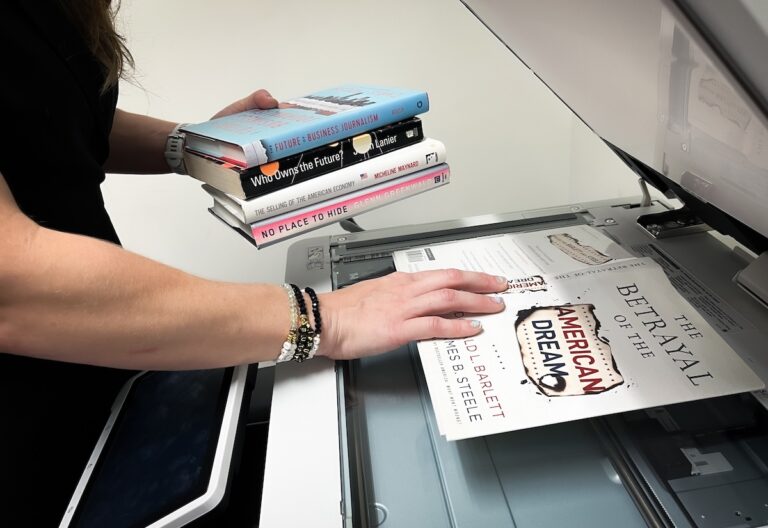
The Authors Guild notes that AI books “not only deceive customers, but siphon off from sales of legitimate books”, and it has been pushing for Amazon to do more to ensure these books are properly labeled for consumers. However, Amazon has been reluctant to do so thus far, and stopping AI slop may not be high on the company’s list of priorities, considering its own investment in AI. For example, a recent investigation by 404 Media found that Amazon was “scanning and destroying a large shipment of rare books so it can train its AI models,” and it isn’t the only AI company doing so. Anthropic, the creator of Claude, was also recently found to be destructively scanning older texts in order to avoid working directly with (i.e. paying) actual authors. By consuming these texts, Anthropic hoped that their “well-curated facts, well-organized analyses, and captivating fictional narratives” would help “Claude write as accurately and as compellingly as Authors.”
Whether or not the quality is any good, AI is certainly helping people publish books. It is estimated that more than 3.5 million books were self-published last year and, while it is hard to know how many of those titles were either written by AI or AI-assisted, some research has pointed to as many as half of those self-published titles could be put in that category.
Additionally, some AI books are finding their way through traditional publishing houses and onto store shelves where many readers may be completely unaware they’re reading AI slop or potentially even reworked renditions of actual authors’ work. As one published author told the New York Times this year, “You’re talking about directly pirating my work, putting it into an engine so that you can produce a [similar type] book, and then glutting the market with it… It essentially erases actual authors.”
Who’s left to sell, and profit from, the art?
Authors aren’t the only creatives seeing their work pirated by AI machines and sold for someone else’s profit. Artists on Etsy specializing in handmade creations have seen their sales slowly decrease as the platform continues to allow AI-generated art, some of which may even copy their exact work. Sellers have complained that Etsy isn’t doing enough to follow up on AI complaints, and some have even had their own work flagged as AI-generated, despite being the original creator.
New platforms have been created for artists in the past couple of years in an attempt to keep out AI slop, but that doesn’t guarantee creative work won’t be consumed for more of the same. One such platform, Cara, recently had its entire platform scraped by an AI enthusiast despite implementing “anti-bot and anti-scraping measures, making it clear that they didn’t want their users’ data scraped.”
While there are real arguments for the efficiency of AI, and some creators appreciate its assistance in scaling their creative work, AI slop is “content built purely to farm views, harvest subscribers, and extract ad revenue,” and not for the original creators. As one designer told The Guardian, “From a creative standpoint, AI is made off the backs of other people’s labor, and other people get rich off it.”