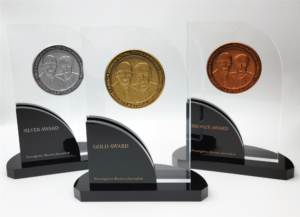


An investigation tracing toxic lead from Nigerian recycling plants into the supply chains of some of the world’s best-known carmakers, and an exposé of Mexico’s booming but largely ineffective surveillance industry, have won top honors in the 2026 Barlett & Steele Awards, which mark 20 years of recognizing the best in investigative business journalism.
The Examination and The New York Times won the Gold Award in the Global/National category for “The Poisonous Lead Trade,” and POPLab and Connectas took Gold in the Regional/Local category for “The Profitability of Fear.” Barron’s reporter Nick Devor received the Outstanding Young Journalist Award for his coverage of the gambling industry. The Reynolds Center for Business Journalism at Arizona State University’s Walter Cronkite School of Journalism and Mass Communication, which administers the awards, will spotlight the top winners at an event Nov. 9 in downtown Phoenix.
“This year’s winners underscore the incredible role in-depth investigative business journalism can play in keeping the public informed about the issues that affect their well-being and way of life,” said James B. Steele, half of the Pulitzer Prize-winning investigative duo Barlett & Steele for whom the awards are named. “Using the latest as well as time-honored reporting tools, these journalists shine a light on abuses committed by powerful interests.”
This is the fifth year that the Barlett and Steele Awards have recognized publications across two distinct categories, Global/National and Regional/Local, in order to honor more of the incredible investigative work being done across the United States. Each category features a Gold, Silver, and Bronze award. These awards come with cash prizes of $3,000, $2,000, and $1,000, respectively. The Outstanding Young Journalist Award features a cash prize of $3,000. The Barlett and Steele Awards are named for the illustrious investigative business journalist team of Donald L. Barlett & James B. Steele.
The Gold Award in the Global/National category was won by a team of reporters from The Examination and The New York Times for an impactful investigation into an American company that supplied some of the world’s most recognizable carmakers with lead from shoddy factories in Nigeria that was poisoning workers and residents. The Poisonous Lead Trade prompted swift reaction from the Nigerian government and attracted widespread attention across the country, while also pressuring American car companies to improve oversight of their supply chain.
The Silver Award in the same category went to an investigation by Reuters reporters that looked into Donald Trump’s crypto wealth and explored the cost to everyday people who believed the president’s promise of a new kind of finance. The Bronze award goes to “Cancer Calculus,” a yearlong investigation by the International Consortium of Investigative Journalists, which revealed a devastating portrait of a health care system that has created global inequity in accessing necessary cancer medications, and the lengths one pharmaceutical company went to ensure prices and revenue remained high.
The Gold Award in the Regional/Local category goes to The Profitability of Fear by a team of reporters from POPLab and Connectas, which covered how insecurity became a big business in Mexico and how the same company that has yet to fulfill promises of safer communities is also expanding its presence in the United States. The investigation revealed patterns of opaque contracting, unverifiable results, and a structure that is bound to invite corruption.
The Silver Award in this category goes to the San Francisco Chronicle for its investigation “Failed to Death,” which exposed how the country’s largest behavioral health companies exploited a state regulatory loophole, allowing the companies to reap massive profits while patients suffered the consequences. The Bronze Award goes to SMUGGLED, a collaboration between The Marshall Project-Cleveland, the Columbus Dispatch, and the Cincinnati Enquirer that investigated the constant flow of illicit drugs into Ohio prisons that has doubled the discipline for incarcerated people, despite millions of tax dollars spent on security upgrades.
The Outstanding Young Journalist Award goes to Nick Devor of Barron’s for a series of coverage on the gambling industry that ranged from the 1-800 addiction helpline to regulating prediction markets and focused on the industry’s massive impact across society and the potential harm to Americans’ wallets and mental health.
“Twenty years after these awards were created to honor the best in investigative business journalism, the change-making work submitted for consideration continues to demonstrate the centrality of business in people’s lives,” said Dr. Jeffrey Timmermans, director of The Reynolds Center for Business Journalism. “It’s incredibly encouraging to see such great reporting in such a variety of publications, as well as the collaborative nature of the top entries.”
About the winners
Gold – Global/National Category
In a story that influenced the Nigerian Senate to declare a national emergency, The Examination and New York Times reported on the dire conditions workers and nearby residents of the local lead recycling industry were experiencing. “The Poisonous Lead Trade” reported that 70% of volunteers working or near lead processing factories, which supplied materials to American carmakers, had dangerous levels of lead poisoning and soil testing revealed conatmination near schools, markets and homes.
The judges noted that what made this piece stand out was the significant effort the publications made to ensure that the people most affected by the story were also able to read it. This meant partnering with local news outlets to share findings so they could report their own stories under their own bylines, in their own language, to reach residents and policymakers that could act. This was a true testament to the power of a collaborative press and the impact that is possible when good investigative reporting meets compassion that centers the human in every story.
Silver – Global/National Category
A team of reporters at Reuters pulled back the curtain on Donald Trump’s crypto business ventures that highlighted the president’s conflicts of interests and the playbook that allowed the Trump family to invest little-to-nothing and walk away with billions. Using Trump’s disclosure reports, crypto trade information, and property and financial records released by the courts, the reporters calculated the family made $2.3 billion, while retail buyers and investors lost vast sums of money.
In the first half of 2025, the president’s family raked in more than $800 million in sales from crypto assets, much of which came from foreign sources. Despite the claims of separation between the presidency and his family’s businesses, the reporters showcase that the relationship remains blurred and is a story worth documenting.
As the judges noted, the stories included “intricate details, demonstrated very strong reporting chops, and illuminated the unprecedented conflict of interest between Trump’s family crypto ventures and his public role as overseer of U.S. crypto policy.”
Bronze – Global/National Category
“Cancer Calculus” began with a tip from a Russian pharmaceutical representative who alleged corruption in global drug pricing that prompted a large collaboration between the International Consortium of Investigative Journalists (ICIJ) and 47 media partners in 37 countries. Through hundreds of interviews, with doctors, patients, experts, regulators, and individuals impacted by cancer around the globe, the reporters were able to demonstrate how the cancer drug Keytruda was just one blaring example of a broken global system meant to deliver care.
The investigation found that the company Merck, which owns Keytruda, had exploited the global patent system to prevent cheaper alternatives from coming to the marketplace while the company raked in $31.7 billion in revenue from the drug in 2025 alone. In the United States the medication can cost a staggering $208,000 a year prompting patients to seek the drug outside the country where it is considerably cheaper. The reporters found multiple cases where this dynamic had created the opportunity for counterfeiters to cash in on the demand at the expense of cancer patients.
As the judges noted, “these stunning reports could easily be titled ‘Profits over Patients’ as it showcases a health care system that has created global inequities in access to pricey cancer drugs, as drug counterfeiters take advantage.”
Gold – Regional/Local Category
“The Profitability of Fear,” an investigation by POPLab and CONNECTAS, examined how the Mexican government consistently responded to rising violence with an increase in surveillance technology. Despite billions in public funds spent on cameras, drones, and other monitoring systems, violence continued to increase in many states and the technology often failed when relied on to solve crimes.
The reporters pored over more than 700,000 internal fiscal records and revealed a pattern of opaque contracting that was ripe for corruption. Additionally, they found that the surveillance systems were occasionally being used for purposes outside of crime prevention, including identifying and monitoring people participating in protests. After the investigation was published, the Mexican president announced audits of surveillance contracts receiving federal funding.
The judges believe that “the scope, importance, and impact of this investigation, accomplished in the most challenging of environments, make it the clear winner this year.”
Silver – Regional/Local Category
The San Francisco Chronicle investigation, “Failed to Death,” began with a tip from a former patient who said he was locked inside a psychiatric hospital. Cynthia Dizikes and Joaquin Palomino found that between 2019 and 2024, 18 people had died after receiving care at California for-profit psychiatric hospitals and 12 of those deaths occurred at Signature Healthcare Services facilities. Patients and families reported assaults, lack of supervision, and wrongful discharges, while state inspectors found understaffing and other safety failures.
The reporters examined public records, financial data, internal communications, confidential documents, and thousands of pages of sworn testimony. They found that Signature’s hospitals had reported paying more than $200 million to companies controlled by or connected to its CEO since 2011. The investigation also found that the CEO had sold six hospital properties for $380 million in 2017 and leased them back at higher rates, potentially diverting money from staffing and patient care. Following the investigation, California adopted the nation’s first minimum nurse-to-patient ratios for psychiatric hospitals and imposed $1.8 million in fines connected to the impact of the Chronicle’s reporting.
The judges noted that this was a rigorous investigation into a national problem and “a prime example of giving voice to the voiceless by meticulously exposing a mental health care system that delivers hundreds of millions of dollars in profits while patients suffer.”
Bronze – Regional/Local Category
A drug-soaked paper known as K-2, the most common drug in Ohio prisons, was at the center of a year-long investigation by The Marshall Project – Cleveland, Columbus Dispatch, and Cincinnati Enquirer. Through hundreds of records, hours of prison footage, and interviews with those inside and outside state prisons, the reporters found that despite increased security measures, drugs were still finding their way inside prison walls. They found that too often staff smuggled in the drug and got off with no charges, while other smugglers continued to find new methods to funnel drugs inside, including using drones to drop them over prison walls, as no one was truly being held accountable.
Because of this reporting, state lawmakers are considering stronger drug smuggling penalties, and a county prosecutor dropped criminal charges for an incarcerated whistleblower in a drug smuggling case. According to the judges, this investigation was “an eye-opening deep dive into a topic that’s received little attention elsewhere.”
Outstanding Young Journalist
Barron’s reporter, Nick Devor, delivered a landmark story on a New Jersey court decision to remove the national 1-800-Gambler helpline’s national sponsor and return millions in donations. Devor was the only reporter in the room when the decision was made and his reporting uncovered how the helpline sat at the front of a debate on national vs. local caller support and why advocates expressed relief when the helpline lost its national sponsor. He also revealed that the regulatory body in charge of overseeing the fast-growing prediction market industry had been dwindled down to a single enforcement attorney, meaning there was no better time for corrupt actors to make their plays.
Devor’s coverage of the gambling industry has repeatedly produced exclusive reporting that not only breaks important news, but holds the powerful accountable. This is why the judges believed Devor was a perfect example of what the Barlett and Steele Awards stand for and is why he was chosen as this year’s Outstanding Young Journalist. The judges look forward to seeing what Devor reports next.
—
The Reynolds Center will spotlight the recipients of the top prizes at an event on Nov. 9 at 5 p.m. Arizona time in the First Amendment Forum at the Cronkite School in Downtown Phoenix. Tune in to The Reynolds Center event page for updates on the live event.